
Stormwater
Goals
- Contain and percolate all stormwater on-site
- Protect soil and ground water by capturing known acute releases and reduce chronic contamination of the environment
- Emphasize permanent, reliable low maintenance pollution source controls
- Eliminate or protect pathways to prevent stormwater pollution
Implementation Efforts
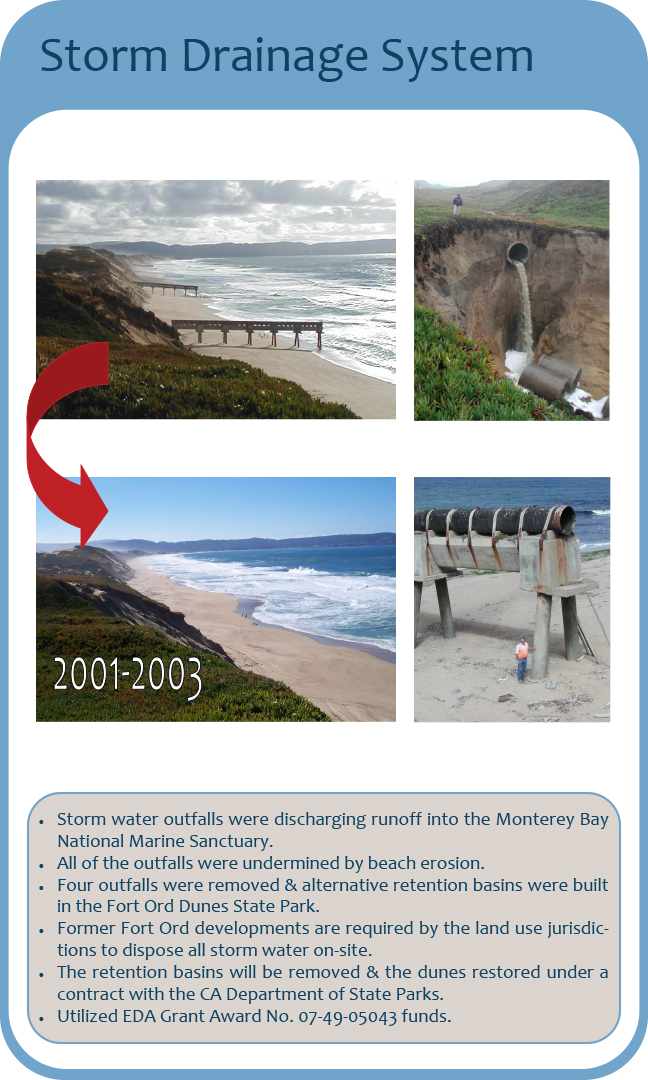
In 1994 the University inherited degraded stormwater infrastructure which conveyed the former Fort Ord runoff into the Pacific Ocean. In 2003, to protect water quality, the Fort Ord Reuse Authority disconnected two 48" and one 54" ocean outfalls and created ponds to capture and infiltrate stormwater runoff west of Highway One. Currently no stormwater from CSUMB drains into the Bay or any surface waters of the United States.
As the campus continues to grow, new projects continue to design runoff to infiltrate into new basins within building footprints (building and site scale) or consolidated percolation ponds (campus scale) and minimize connection to the existing storm drain system. In addition, over 344 structures have been demolished along with pavement and walkways. These efforts have greatly increased the amount of impervious surface on campus. In 2006 a Stormwater Master Plan was developed to further guide these efforts and support the stormwater goals of the University.
To find out more about stormwater management practices you can read the Stormwater Master Plan and the latest Campus Master Plan : Chapter - 8 Water Systems.
Projects
Joel and Dena Gambord Business and Information Technology - Bioretention Pond
Bioretention
Bioretention is the process by which contaminants and sedimentation are removed from stormwater runoff. This process involves the collection of stormwater, which is allowed to pond to slow down the runoff velocity, thus increasing the contact time with the surface organic layer and soils. The treated runoff infiltrates over a period of time into the underlying soils

7th Ave Realignment - Green Street / Bioswale
Bioswales
Swales are shallow drainage ways that employ landscaping to stabilize the soil while providing water quality treatment through biofiltration. They are designed to remove silt- and sediment-associated pollutants before discharging to storm sewers, and to reduce the volume of discharge if soils allow for infiltration. The treatment area can be planted in a variety of grasses, sedges, and rushes, while the side slopes can be planted with shrubs or groundcover.
Green Streets
The addition of pockets or strips of vegetation within or adjacent to streetscapes provides a means for runoff to re-enter the soils through infiltration. These spaces also provide conveyance of both street runoff and flows from adjacent parcels to larger retention areas.

Documents
- Draft Campus Master Plan - Chapter 8: Water Systems
- 2006 Stormwater Master Plan
- 2006 Stormwater Master Plan Drawing Set
- 2005 FORA Stormwater Master Plan