
Jeffrey Trevino
Biography
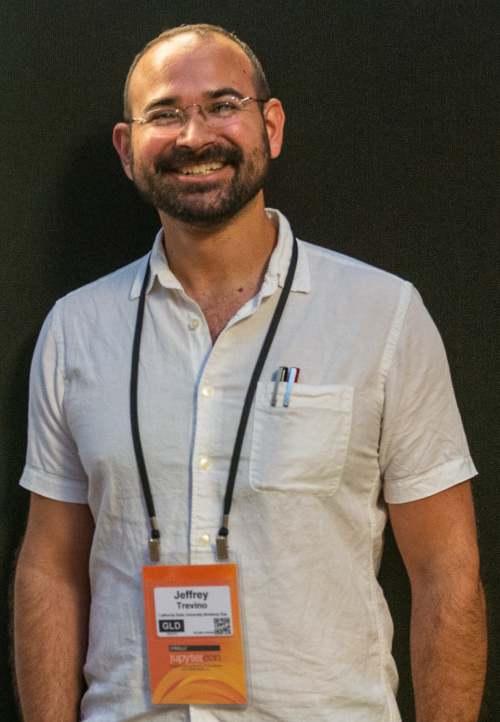
Jeffrey Treviño received the B.A. in Music, Science, and Technology from Stanford University's CCRMA (Center for Computer Research in Music and Acoustics) and the M.A. and Ph.D. degrees in Music Composition from the University of California at San Diego. Before coming to CSUMB, he taught as a Visiting Assistant Professor at Carleton College in Northfield, Minnesota and as an Assistant Professor at Colorado College in Colorado Springs, Colorado. His research and creative practice focus on feedback between symbolic representation, human–computer interaction, and sonic creativity, with an emphasis on the way novel technologies and representations impact established conventions of theory and artistic practice.
As a composer, his orchestral, chamber, and solo acoustic and electroacoustic works have been premiered internationally by acclaimed soloists and ensembles at the Oberlin Conservatory Percussion Institute, the International Computer Music Conference, New York City’s Symphony Space, the Seoul International Computer Music Festival, Mexico’s Visiones Sonoras Festival, SIGGRAPH, the International Conference of the Society for Improvised Music, the Freiburg Hochschule für Musik, June in Buffalo, Portugal’s Vila Real Conservatory, New York City’s Miguel Abreu Gallery, the Carlsbad Music Festival, Berlin’s Hanns Eisler Akademie, the Mayo Clinic, and Mexico's National Center for the Arts in Mexico City. Treviño has shared his creative work at renowned festivals and universities, and is in demand as a guest teacher and presenter; most recently, he offered composition masterclasses, lectures, and workshops as an invited composer in residence at the Ecos Urbanos (Mexico City) and Dias de Música Electroacústica (Seia, Lisbon) festivals of electronic music. He has been an invited composer in residence at Stuttgart's Akademie Schloss Solitude, the Banff Centre for Arts and Creativity, and the Escola Superior de Música e Artes do Espetáculo, Porto.
An accomplished pianist and tubist, he has performed in world class venues such as Carnegie Hall, Walt Disney Concert Hall, the Sheldonian Theatre, and the Sydney Opera House. Most recently, he performed John Cage's seventy-minute, twenty-movement work for prepared piano, Sonatas and Interludes, at The Lab in Carmel, an event featured in The Carmel Pine Cone, The Monterey County Herald, and The Monterey County Weekly.
As a music technology researcher and software developer, Treviño's reviews and research into philosophies of musical expression, the design of electronic instruments, and automated data visualization for historic performance practice have been published in Computer Music Journal (MIT Press) and the Journal of Computing and Cultural Heritage (Association of Computing Machinery), and presented at the International Conference on New Interfaces for Musical Expression; the MIT Museum exhibited his installation Variations in its 2014-15 exhibit, Inventions. He contributes Python code and evangelism to the Abjad API for Formalized Score Control (Trevor Baca and Josiah Oberholtzer) and initiated the nCoda project -- an open-source, scriptable, collaborative music notation editor -- with Christopher Antila. Treviño is the audio analysis and experimental design consultant to National Geographic's "Nature Nurtures" initiative, and, most recently, his research into novel methods of data-driven, interactive storytelling for electronic music, music theory, and music composition teaching and learning has been supported by Capital One, O'Reilly Media, NumFOCUS, and Netflix.
Recent Publications
"Music Composition and the Technologies of Working Together: Towards an Assessment of Technology's Impact on the Structure and Incidence of Collaborative Music Composition" in Ideas Sonicas / Sonic Ideas. Daniel Quaranta and Edgar Barroso, eds. Vol. 9, No. 18. pp. 29-32.
“The Sound of Alaska’s Yellow Cedar Trees” in We Can Stay Here While We Wait — Voices in the Anthroposcene, Maya Byskov, Sissel Thastum, Line Thastum, eds., ( Arhus: Narayana Press, 2017), pp. 204-211.
“A Hierarchic Diff Algorithm for Collaborative Music Document Editing” in Proceedings of TENOR2017: The Third International Conference on New Technologies for Music Notation and Representation, June, 2017, A Coruña.
“Discontent in Retrospect” in A NIME Reader: Fifteen Years of New Interfaces for Musical Expression (Springer, 2017).
“Expression and Its Discontents” (republication) in A NIME Reader: Fifteen Years of New Interfaces for Musical Expression (Springer, 2017).